





Infrared saunas have quietly moved out of day spas and into home wellness routines over the last decade. With that shift, equipment is improving quickly. Walk into any home wellness retailer, or scroll through the growing number of online sauna brands, and you’ll find dozens of options at very different price points, all promising the same relaxation and recovery benefits.
The truth is that not all infrared saunas are built the same way, and the differences aren’t always visible from a product photo. If you’re weighing up your first home unit, here’s what actually matters before you buy.
1. Understanding heating panels: carbon, ceramic, or full-spectrum
Most home infrared saunas use infrared heating panels that fall into three broad categories, with key differences that run deeper than the spec sheet.
● Carbon-composite panels are the current standard in quality far-infrared saunas. Built into the cabin walls, they radiate heat evenly across a large surface area at comparatively low operating temperatures, which is part of why infrared saunas can run a comfortable session at 45–60°C rather than the much higher air temperatures of a traditional sauna. Well-made carbon panels are also built to last, with a typical service life measured in tens of thousands of hours of use.
● Ceramic heaters were the earlier generation of infrared technology. They’re a smaller, more concentrated heat source, which means they run at a much higher surface temperature and tend to create uneven heat, which is warmer directly in front of the element but cooler elsewhere in the cabin. They’re also shorter-lived than carbon panels.
● Full-spectrum saunas, which use halogen bulbs to add near-infrared and mid-infrared wavelengths, are the newest marketing category, and the one most worthy of scrutiny. Independent spectrometer testing has repeatedly shown that the near-infrared dose these bulbs actually deliver at a normal sitting distance (60–90cm) is a fraction of what’s claimed, while halogen elements can run at surface temperatures high enough that safe positioning inside a small cabin becomes difficult. If a full-spectrum unit is on your shortlist, ask the retailer for independent third-party test data, not just the marketing copy.
2. Ask about EMF and ELF, not just “low EMF”
Any electrical heating element produces some level of electromagnetic field (EMF) and extremely low frequency (ELF) electric field. The World Health Organization’s position is that typical low-level EMF exposure in daily life is not established as a health risk, but the general advice for any appliance you sit close to for extended periods is to minimise unnecessary exposure where practical (World Health Organization, 2005).
“Low EMF” is one of the most overused phrases in sauna marketing, and it’s rarely backed by a number. Before buying, ask the manufacturer for actual independent measurements—not just the claim—and ask at what distance the measurement was taken, since EMF and ELF readings can vary enormously depending on how close the sensor sat to the panel.
3. Check what the cabin is actually made of
Timber choice affects both durability and how the sauna feels to sit in.
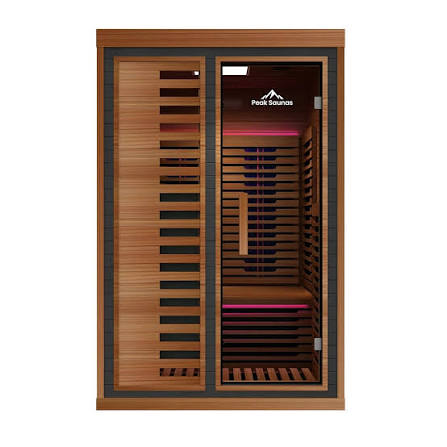
● Canadian Hemlock is a common premium choice. It’s a dense, tight-grained softwood with minimal natural oils or resins, which matters because sauna wood is repeatedly heated over years of use.
● Western Red Cedar was the traditional sauna timber of choice for decades, but it’s increasingly avoided in enclosed heat environments because of its association with occupational asthma and skin or respiratory irritation, driven by a compound called plicatic acid in the wood. It’s a well-documented issue in cedar-mill workers and has been studied for decades (Washington State Department of Labor & Industries); the same compound is present in a home cedar sauna, just at a smaller scale and lower repeated exposure.
Two other build details worth asking about: whether the panels are assembled with food-safe, water-based adhesives (standard wood glues can off-gas under sustained heat), and whether the heater panels themselves are exposed or covered in a synthetic fabric sleeve. Covered panels are common; they reduce the direct infrared output and add another material that heats up repeatedly over the sauna’s lifespan.
4. Size your infrared sauna to your space, not just your budget
As a rough guide, allow:
● 2–3 square metres for a one-person unit
● 3–4 square metres for a two-person unit
● 4–6 square metres for a three-person unit
● 6–8+ square metres for a family-size unit
Beyond the footprint, leave a few centimetres of clearance on every side for ventilation, and think honestly about how you’ll actually use it — a compact one-person cabin suits a daily solo routine, while a larger unit makes more sense if you’re sharing sessions with a partner or family.
5. Confirm the electrical certification and real running costs
Because a sauna is a high-draw electrical appliance running in a warm, enclosed space, electrical certification isn’t optional. In Australia and New Zealand, look for compliance with AS/NZS 60335.1, the joint household appliance safety standard (Standards Australia); if you’re shopping in the US, UK, or Europe, ask for the equivalent UL or CE certification instead. Most single-person and two-person units run comfortably on a standard household power point, though larger multi-person cabins may need a dedicated circuit. Confirm this with an electrician before delivery day, not after.
On running costs, infrared saunas are quite efficient compared with traditional saunas. A mid-size unit typically costs somewhere in the range of a dollar or less per session to run, which adds up to well under what a traditional steam or wood-fired sauna costs to operate over a year.
6. Read the warranty like you mean it
A sauna is a long-term purchase, and the warranty tells you how confident the manufacturer actually is in their build. Look for cover that extends to the whole unit — heaters, control panel, cabinet, even the light fittings — rather than a shorter window on parts alone. And ask a practical question most buyers skip: if something does need attention in five years, is there a local service contact, or are you on your own with an overseas warranty claim?
A quick checklist before you buy your first home infrared sauna
● Carbon panel heaters with full front-and-side coverage—not partial
● Independent EMF/ELF test data, rather than a mere “low EMF” label
● Hemlock or another low-irritant timber, food-safe adhesives, and exposed (not fabric-covered) panels
● Sizing that matches your actual space and how many people will use it
● Certified to your region’s electrical safety standard
● Whole-of-unit warranty with accessible local support
You’ll sit in, breathe near, and rely on your infrared sauna for years.
That makes it worth a slower decision than most home purchases. Run any unit you’re considering through the checklist above, regardless of brand, and you’ll end up with a sauna that’s genuinely worth the space it takes up.
About the Author
Mark Idour is the owner of Sun Stream Saunas Australia, a family-owned infrared sauna distributor. Sun Stream Saunas was established in 1999 and operates across Australia, New Zealand, the UK, Europe, Canada, and the US. Mark has spent more than two decades working directly with infrared heating technology, from early nano-carbon panel design through to low-EMF heater systems. He contributed this guide through the Prime Healers’ write for us health tips program to help readers make safer, better-informed home wellness purchases. Based in Australia, learn more about his work at Sun Stream Saunas.
Sources
- World Health Organization, “Radiation: Electromagnetic fields”
- Washington State Department of Labor & Industries, “Asthma & Western Red Cedar”
- Standards Australia, AS/NZS 60335.1:2020