





Most of us read a product label the way we read a menu. We look for the name, check the amount, maybe glance at the fine print, and move on. For a bottle of vitamin D or a tub of protein powder, that habit has never caused much trouble. The label is a promise, and most of the time the promise holds.
The trouble is that a label is written by the company selling the product. It tells you what the seller says is inside, not what anyone measured. When a third party has tested a batch, the evidence lives somewhere else, in a document called a certificate of analysis. Learning to read one takes about ten minutes, and it changes how you shop for anything that claims to be pure, potent or tested.
This guide walks through that document line by line. The examples come from supplements and from laboratory research materials, because both markets lean heavily on testing claims, and both have plenty of sellers who use the word “tested” more freely than they should.
What a certificate of analysis is
A certificate of analysis, usually shortened to COA, is a report from a laboratory describing what it found when it tested a specific sample. A proper one names the product, the batch it came from, the tests that were run, the methods used and the results. It is dated, and it identifies the laboratory that did the work.
The key word there is specific. A COA describes one sample from one batch, tested on one date. It is not a general statement about a product line. A supplement company that made ten batches of the same capsule this year should, in principle, have ten certificates. If a seller shows you one certificate for everything they have ever sold, you are looking at a sample report, not proof about the jar in your cupboard.
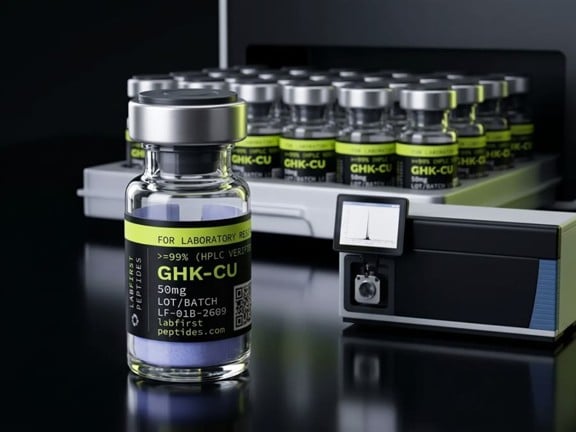
A tested research lot beside a mass spectrometer, the identity check on a lab certificate, LabFirst Peptides
The three questions a good certificate answers
Most of the confusion around lab reports goes away once you know what they are supposed to answer. A complete certificate addresses three separate questions, and each one needs its own test.
### 1. Is it the right substance?
This is identity. It sounds too obvious to bother checking, but substitution and mislabeling are some of the most common problems in loosely regulated markets. Identity tests compare the sample against what the substance should look like at a chemical level. For many compounds that means mass spectrometry, which measures molecular weight and checks it against the known value.
On the certificate, look for a line that names the identity test and gives a result such as “conforms” or a measured mass next to the expected one. If there is no identity line at all, the report has skipped the most basic question.
### 2. How pure is it?
Purity tells you what share of the sample is the substance you wanted, as opposed to leftovers from manufacturing, breakdown products or other contaminants. For many products this comes from a method called HPLC, which separates a sample into its parts and measures each one.
A purity result is usually shown as a percentage. It is the number sellers love to advertise, and it is useful, but it has limits. It describes the proportion of what the instrument detected. It does not tell you how much material is in the container, and on its own it does not prove the substance is the right one.
### 3. How much is actually there?
This is content, sometimes called assay or potency. A label might promise 1,000 IU of a vitamin or 10 milligrams of a compound. The content test measures how much is present.
This is the line people skip most often, and it matters a great deal. A product can be 99 percent pure and still contain less than the label says. In supplements, studies by independent testers have repeatedly found products that came in well under their stated amounts. A certificate that reports purity but not content leaves that question open.
Reading the certificate line by line
Once you know the three questions, the document itself is easier to read. Here is what to check, in roughly the order it tends to appear.
The product name. It should match what you are buying exactly, including the form. Vitamin D3 is not vitamin D2, and an acetate salt is not the same listing as a free base. Small wording differences can mean a different material.
The batch or lot number. This is the most important line on the page. It ties the report to a specific production run, and the same number should be printed somewhere on your package. If the numbers don’t match, the certificate is about some other batch, whatever it says.
The test date. Reports have a shelf life too. A certificate from three years ago tells you little about a batch made last month. For products that degrade over time, a recent date matters even more.
The laboratory. The report should name the lab that did the testing, with enough detail that you could contact it. A logo alone is not enough. Look the lab up yourself rather than relying on contact details printed on the report.
The methods. Each result should say how it was measured. “HPLC” next to purity and “mass spectrometry” next to identity are typical pairings for many compounds. A result with no method is harder to judge, because you can’t tell how reliable the number is.
The results and specifications. Good reports show the actual measured value alongside the acceptance range, for example “measured 99.2 percent, specification at least 98 percent.” A page that just says “pass” without numbers is telling you much less than it appears to.
A report or verification code. Many labs now let anyone confirm a report on their own website by entering a code. If the certificate has one, use it. This single step catches most altered or invented reports, because a forged PDF can look perfect while the code leads nowhere.
Why verification matters more than the PDF
It is surprisingly easy to produce a convincing lab report. Templates circulate online, logos are simple to copy, and most buyers never check anything beyond the purity number. That is why the most valuable habit is also the simplest: confirm the report with the lab, not the seller.
There are a few ways to do that. If the lab offers an online lookup, enter the code. If it doesn’t, email or call the lab with the report number and ask them to confirm it. Legitimate labs are used to these requests. Some suppliers now go a step further and publish every batch’s report openly, with a link to the lab’s own verification page, so you can check before you buy. LabFirst Peptides, for example, keeps lot reports on a public certificates page, each one linked to the testing lab’s own lookup. That is the standard worth asking any seller for.
You can also look at the lab itself. Accredited testing labs usually list their accreditation, such as ISO/IEC 17025, which covers the competence and consistency of testing labs. Accreditation is a good sign, but it has a scope, so it is worth checking that the specific test you care about is covered.
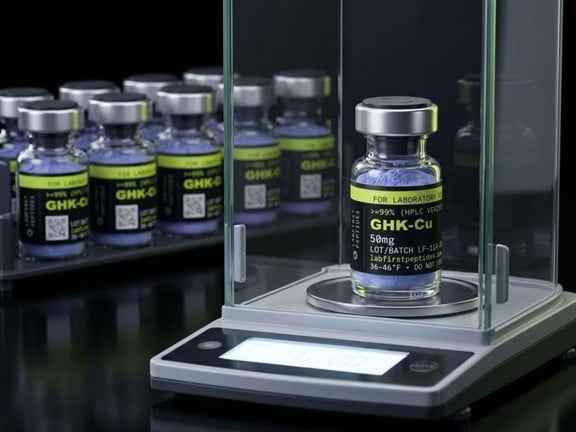
Weighing a vial on an analytical balance, the content check on a lab certificate, LabFirst Peptides
Red flags that should make you pause
None of these prove a product is bad. Each one is a reason to ask more questions before you trust the label.
- No batch number on the report, or a number that doesn’t match your package.
- Only one test. A purity percentage with no identity or content result.
- “Pass” with no numbers. You can’t judge a result you can’t see.
- A lab you can’t find or contact. If the lab doesn’t seem to exist outside the PDF, treat the report with suspicion.
- The same report for every product or every size. Each batch should have its own.
- An old date on a product that is supposed to be fresh.
- Purity numbers that look too perfect, such as a flat 100 percent. Real measurements almost always come with decimals and a small margin.
- A seller who gets vague when you ask for the lab’s contact details or a report for your specific batch.
How this plays out in practice
Supplements are the most familiar example. In the United States, dietary supplements don’t need approval before they are sold, and the company is responsible for making sure its products are safe and accurately labeled. Some brands send batches to independent testers or seal programs. Others rely on in-house testing. Neither the label nor the marketing will always tell you which is which, but the certificate usually will.
Laboratory research materials are another useful example, because buyers in that market have become some of the most skeptical anywhere. Researchers buying compounds for experiments can’t afford material that is mislabeled or short on content, so the better suppliers publish a report for every lot and point buyers to the lab to confirm it. Take Retatrutide, one of the most searched research compounds right now. Listings for retatrutide peptide vary a lot in price, and price on its own says nothing about what is in the vial. The listings worth trusting tie each size to its own lot, show identity, purity and content for that lot, and give a code you can check with the testing lab directly. If you want to see what that looks like on a real document, this walkthrough of a Retatrutide certificate goes through it field by field.
The same habits apply to anything you buy on the strength of a testing claim, from protein powder to essential oils. The details change by product. The questions don’t.
A two-minute checklist
Before you trust a “lab tested” claim, run through this list.
- Ask for the certificate for your specific batch, not a sample one.
- Match the batch number on the certificate to the one on your package.
- Check the date. Recent is better, especially for products that degrade.
- Look for all three answers: identity, purity and content.
- Make sure each result shows a number and a method, not just “pass.”
- Find the lab on your own and confirm the report through its lookup or by contacting it.
- If anything doesn’t line up, ask the seller to explain in writing.
The short version
A label tells you what a seller promises. A certificate tells you what a lab measured, provided it is complete, current and tied to your batch. The single most useful thing you can do is the step most people skip: confirm the report with the lab that issued it.
It takes a couple of minutes, and after you have done it once or twice, a vague report starts to stand out right away. That is the point. You don’t need to be a chemist to tell the difference between a seller who can show their work and one who can’t.
Research peptides mentioned in this guide are sold for laboratory research use only and are not for human or animal use. This guide is general information, not medical advice.
*****